Brain organoids and neuroscience: a research experience at Karolinska Institutet – Gabriele Hamonet
Personal reflections lab rotation
Gabriele Hamonet, Virgilio 7th Cohort Student, Humanitas University
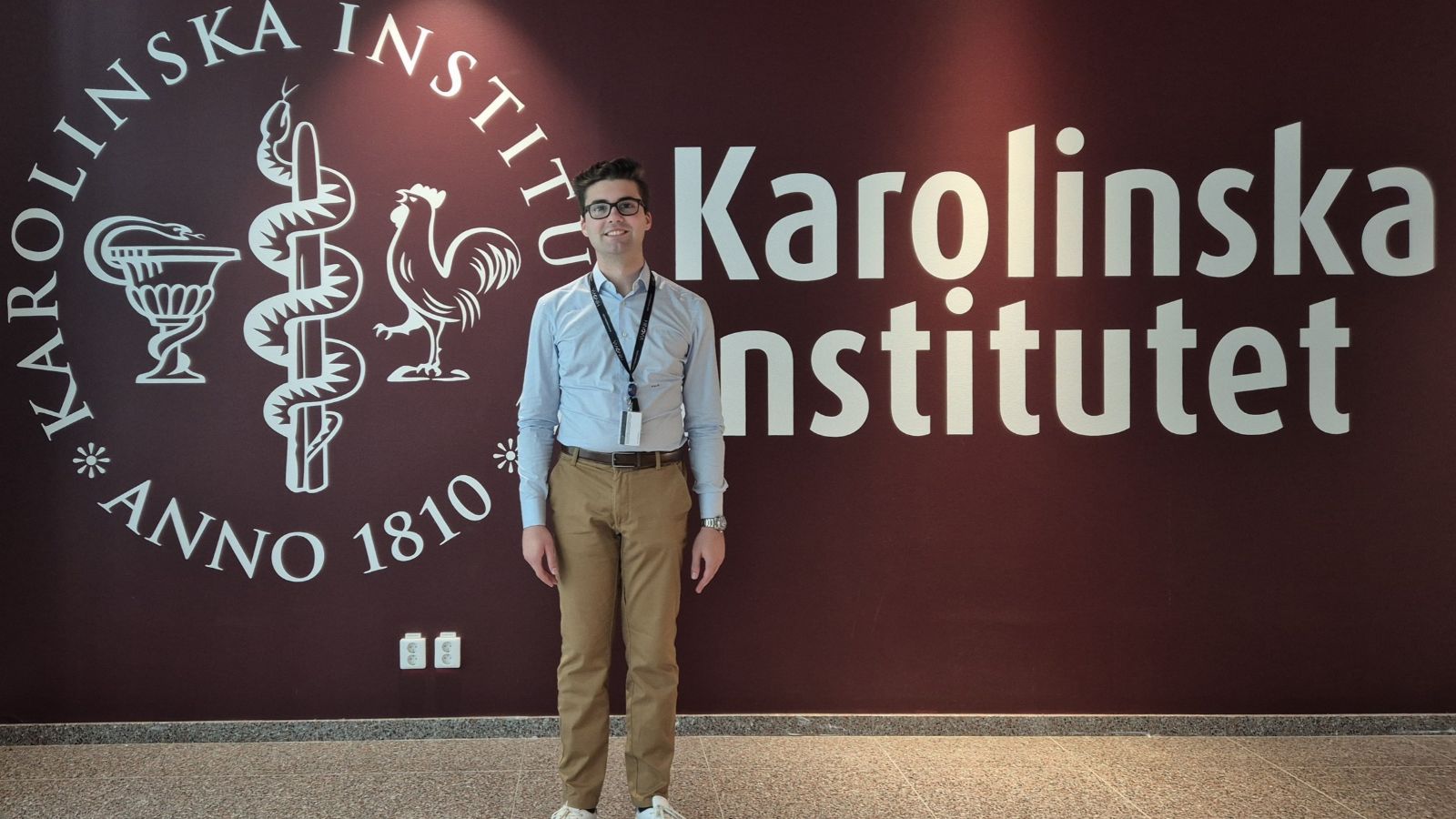
I got the invaluable opportunity to do my 3rd lab rotation at Giske’s Research group, one of the research groups of the Department of Laboratory Medicine at Karolinska Institutet, in Flemingsberg Campus, Stockholm county.
PI: Prof. Christian G. Giske
Tutor: Dr. Mukesh Varshney
Dr. Varshney’s research focuses on the generation and study of brain organoids as physiologically relevant models of neurodegenerative diseases, particularly Alzheimer’s disease, with the aim of investigating disease mechanisms and exploring potential therapeutic strategies.
My experience & learnings:
During my research rotation at the Varshney Laboratory at Karolinska Institutet, I had the opportunity to further develop my experience with brain organoids and deepen my understanding of their application as advanced models for neuroscience and neurodegenerative disease research.
This experience was particularly valuable both professionally and personally. I acquired greater autonomy in laboratory procedures, including cryosectioning of brain organoids, immunofluorescence staining, and fluorescence microscopy. I also had the opportunity to investigate markers of neurons, astrocytes, microglia, amyloid-β, and phosphorylated tau, gaining a better understanding of how experimental models can be used to investigate different aspects of neurodegenerative disease.
However, the most valuable lesson I learnt was that research is a process of trial and error. To illustrate this, I would like to share a small but meaningful example from my experience. During the first immunostaining experiments, I struggled with the final mounting step, particularly with gently placing the coverslip onto the slide without creating air bubbles. At first, the coverslip would slip from my fingers and fall onto the slide, compromising the preparation. Although this was a relatively simple procedure, I needed several attempts to understand how to perform it correctly. With practice, I gradually improved my technique and became more confident. Interestingly, I noticed that as my confidence and familiarity with the procedure increased, the number of mistakes decreased. This taught me that mistakes are not merely failures to be avoided, but opportunities to understand what went wrong and improve the next attempt. I believe this is a fundamental aspect of scientific research, where unexpected results and unsuccessful experiments often lead to new questions, alternative approaches, and better experimental strategies.
Another important aspect of this experience was the laboratory environment. Working at Karolinska Institutet gave me the opportunity to experience an international research setting and to see how scientific knowledge develops through collaboration, discussion, and hands-on training. I particularly appreciated the welcoming and supportive atmosphere of the laboratory, as well as the willingness of my tutor to guide me, answer my questions, and share his expertise.
Overall, this rotation strengthened both my technical skills and my scientific mindset. It reinforced my interest in translational neuroscience and in the use of human stem cell-derived organoids to bridge fundamental research and the understanding of neurological diseases. Most importantly, it taught me to approach laboratory work with greater patience, precision, curiosity, and resilience—qualities that I believe will be essential for my future development as a physician-scientist.
I am deeply grateful to Dr. Mukesh Varshney for his patient and supportive guidance and for giving me the opportunity to better understand what conducting research truly involves. I express my gratitude to the Virgilio Program for this opportunity and to the Vollaro Foundation Scholarship for supporting this invaluable experience.